
Artificial intelligence is becoming part of the everyday workflow of corporate legal departments.
Contracts can be analyzed in seconds. Large volumes of documents can be reviewed and categorized. Drafts can be generated, clauses compared, information extracted, and lengthy materials summarized before a lawyer has even opened the file.
For in-house legal teams under constant pressure to do more with limited resources, the appeal is obvious.
But a new challenge is emerging alongside that efficiency: what happens after the AI finishes its work?
Increasingly, the answer is human verification.
The New Legal Workflow: AI First, Lawyer Second
At LawFlex, we are already assisting clients with this evolving model. Rather than asking lawyers to perform every stage of a document-intensive project manually, an in-house legal department can first use its chosen AI platform to process the material.
The resulting documents and outputs are then provided to LawFlex attorneys for legal review. That is where the second layer begins.
Our lawyers review the AI-assisted work product, identify mistakes or inconsistencies, correct information, edit language, verify data, assess legal conclusions, and make changes where professional judgment is required.
The objective is not to redo everything the technology has already done. It is to make sure the final work product can actually be relied upon.
AI Output Is Not the Same as Legal Judgment
The legal industry has good reason to take verification seriously. Generative AI systems can produce remarkably convincing work while still getting important details wrong. Potential problems range from inaccurate facts and missing information to incorrect citations, outdated authorities, inappropriate contractual language, and conclusions hat fail to account for the specific circumstances of a matter.
The American Bar Association has specifically warned that generative AI tools can produce unreliable or inaccurate information and may generate seemingly plausible information that has no basis in fact. The ABA has also emphasized the importance of lawyers independently reviewing AI-generated work rather than relying on it uncritically.
For legal departments, this creates an important distinction.
AI can accelerate legal work. It does not automatically validate it.
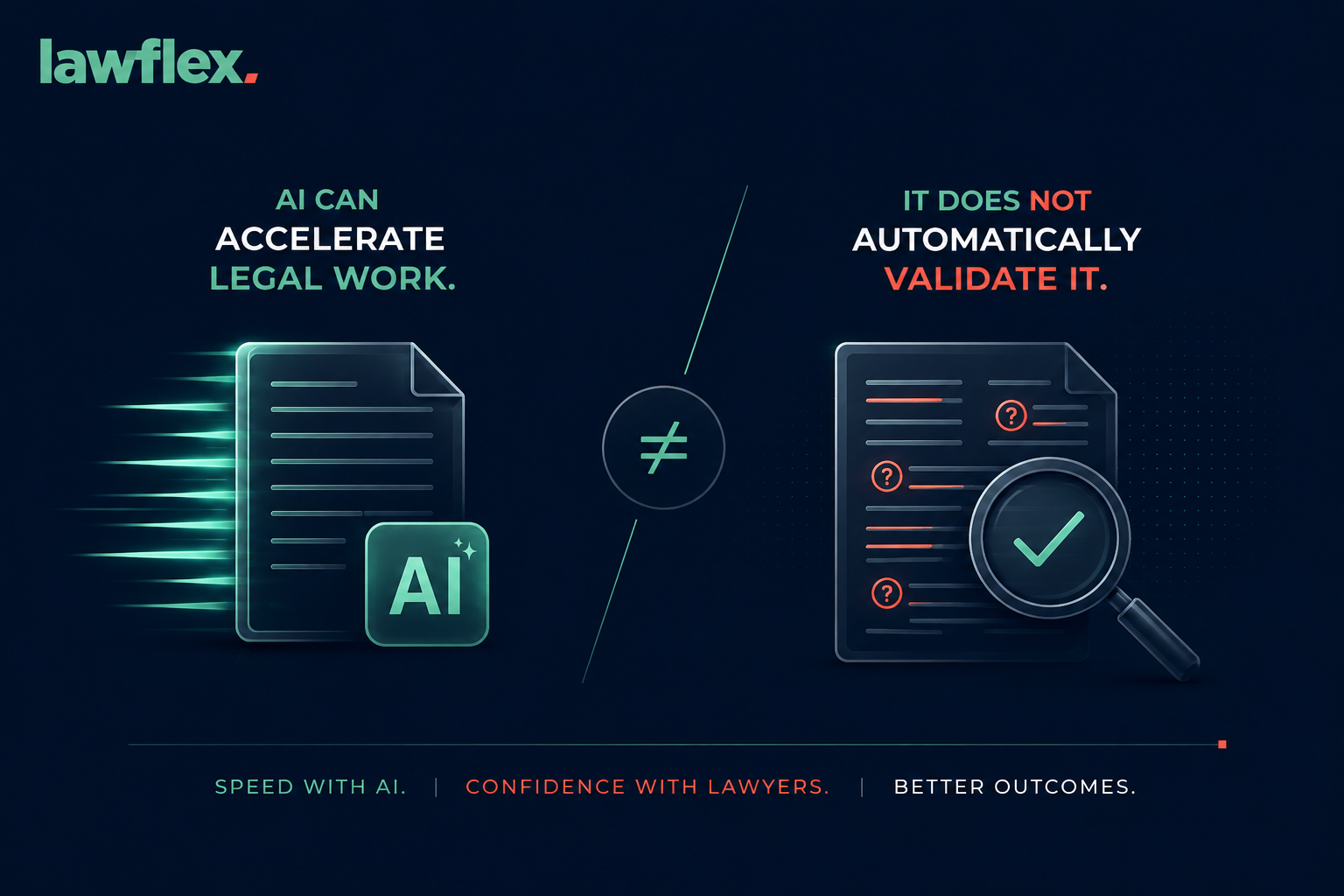
A contract clause that appears reasonable may create an unintended commercial risk. A summary may omit a provision that materially changes the analysis. Data extracted from hundreds of documents may contain errors that are difficult to spot without reviewing the underlying material. An answer may be legally accurate in one jurisdiction but inappropriate in another.
These are precisely the points at which experienced lawyers add value.
Verification Without Losing the Efficiency
Of course, there is an obvious problem with simply telling an in-house legal department to “check everything.” If senior internal lawyers must manually reperform every task completed by an AI platform, much of the efficiency promised by the technology disappears. That is where flexible legal resourcing becomes particularly relevant.
Instead of placing the entire verification burden on the General Counsel or existing in-house team, companies can build a dedicated human review layer around their AI workflows.
Depending on the project, LawFlex can provide attorneys with the relevant legal, industry, language, or jurisdictional experience to review AI-assisted work at scale. The workflow can be straightforward:
AI processes the material → LawFlex lawyers verify and improve the output → the in-house team receives a stronger final work product.
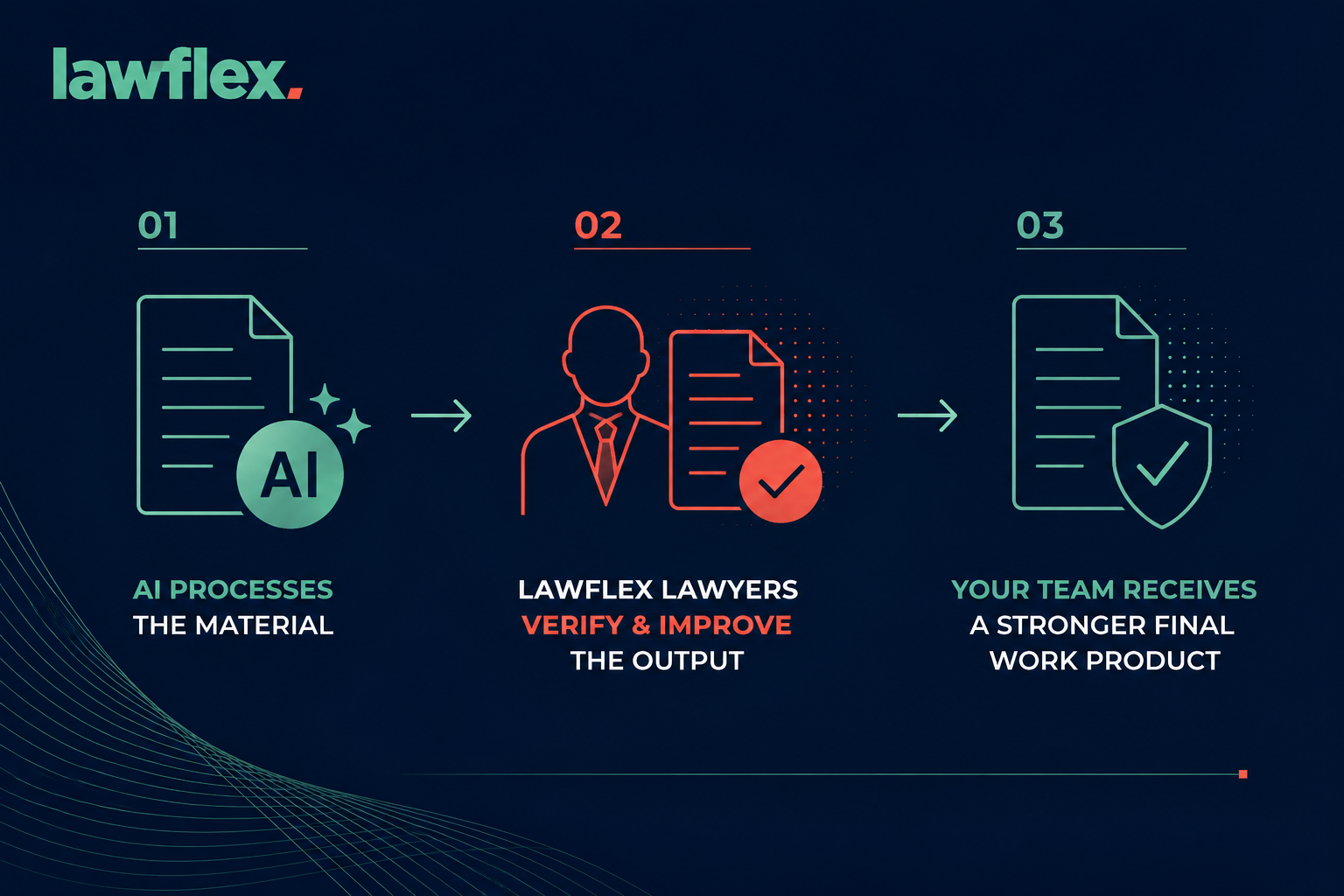
This allows internal lawyers to focus their attention on the decisions that genuinely require their involvement rather than spending valuable time checking every line of AI-generated material themselves.
From Experimentation to Infrastructure
The larger shift here is not really about choosing between artificial intelligence and lawyers. The more interesting question is how organizations combine them.
Legal AI is moving beyond experimentation. As these tools become embedded in contract management, due diligence, legal research, compliance, litigation, document review, and other workflows, verification will increasingly need to become part of the process as well.
That means companies may need to think about human review in the same way they think about the technology itself: as infrastructure that can be scaled according to workload and risk.
Some projects may require one experienced lawyer reviewing a relatively small volume of AI-assisted work. Others may require teams of lawyers reviewing thousands of documents across multiple jurisdictions.
The model can expand or contract with the work.
Technology Accelerates. Lawyers Validate.
The strongest legal operations models will not necessarily be the ones that automate the most. They will be the ones that understand where automation creates efficiency and where human judgment protects quality.
AI can process enormous amounts of information faster than traditional legal workflows ever could. Lawyers bring something different: context, professional judgment, accountability, experience, and the ability to recognize when an answer that looks right is actually wrong.
LawFlex’s AI Verification Services are designed around that combination. We help legal departments add experienced lawyers after the AI stage to review outputs, identify errors, correct information, refine language, and help ensure the final legal work product meets the standards the business requires.
The future of legal work may increasingly begin with technology.
But when the work matters, it should still end with human judgment.
Learn more about LawFlex AI Verification Services:
LawFlex AI Verification Services